
By Liz Schmidt | Women Offshore Blog | Podcast Episode 252
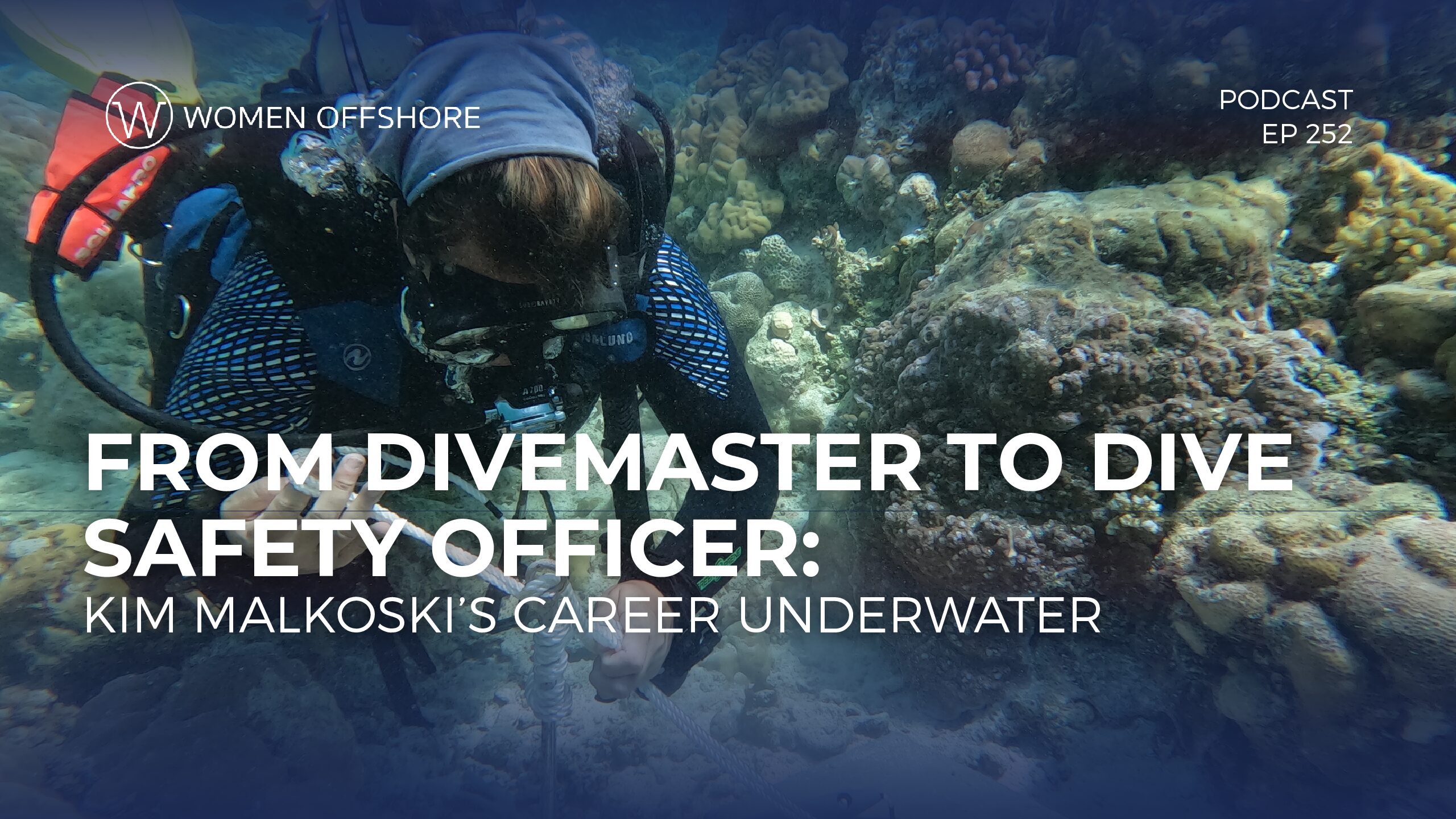
Scientific diving is a specialized discipline that blends operational precision, safety management, and marine research. In Episode 252 of the Women Offshore Podcast, we speak with Kim Malkoski, Assistant Diving Safety Officer at Woods Hole Oceanographic Institution (WHOI), about her path from early ocean curiosity to leading and managing scientific diving programs.
Kim’s connection to the ocean began long before her professional career. She grew up visiting beaches and aquariums, took boat trips with her family, and became scuba certified at just 13 years old. That early foundation set the stage for a career built around both education and safety in marine environments.
After earning her Bachelor of Science in Marine Biology from the University of New England, Kim was certified as a Divemaster and spent two summers at the Monterey Bay Aquarium introducing children ages 8–13 to surface scuba diving. While there, she interned with the Dive Office, where she gained hands-on experience managing scientific divers, maintaining and repairing equipment, and earning certification as an AAUS scientific diver.
Her technical qualifications continued to expand. Kim became a NAUI instructor, SSI instructor, and DAN instructor, further deepening her expertise in dive education and safety protocols. In 2014, she joined Woods Hole Oceanographic Institution as the Assistant Diving Safety Officer, helping oversee and manage the institution’s scientific diving program.
At WHOI, Kim plays a critical role in ensuring compliance, risk mitigation, and operational readiness for scientific divers working in research environments. Her responsibilities extend beyond dive operations. After completing her master’s degree in Sustainability and Environmental Management through the Harvard University Extension Program in 2018, she took on additional administrative leadership, including vessel chartering, scheduling instrument test wells, and overseeing the small boat program.
Kim also consults and teaches with East Coast Divers and previously served as Training Director for five years. Outside of her institutional work, she remains active in the diving community as Vice President of the Boston Sea Rovers, where she was named the 2008 Boston Sea Rover Frank Scalli Intern.
In this episode, Kim discusses what it takes to manage a scientific diving program at a leading oceanographic institution. She shares insights on training standards, safety culture, regulatory compliance, and the evolving demands placed on research divers. The conversation highlights the intersection of operational leadership and marine science, offering listeners a clear view of the infrastructure required to conduct underwater research safely and effectively.
For mariners, researchers, and aspiring scientific divers, this episode provides a grounded look at the systems that support fieldwork beneath the surface.





Recent Comments