
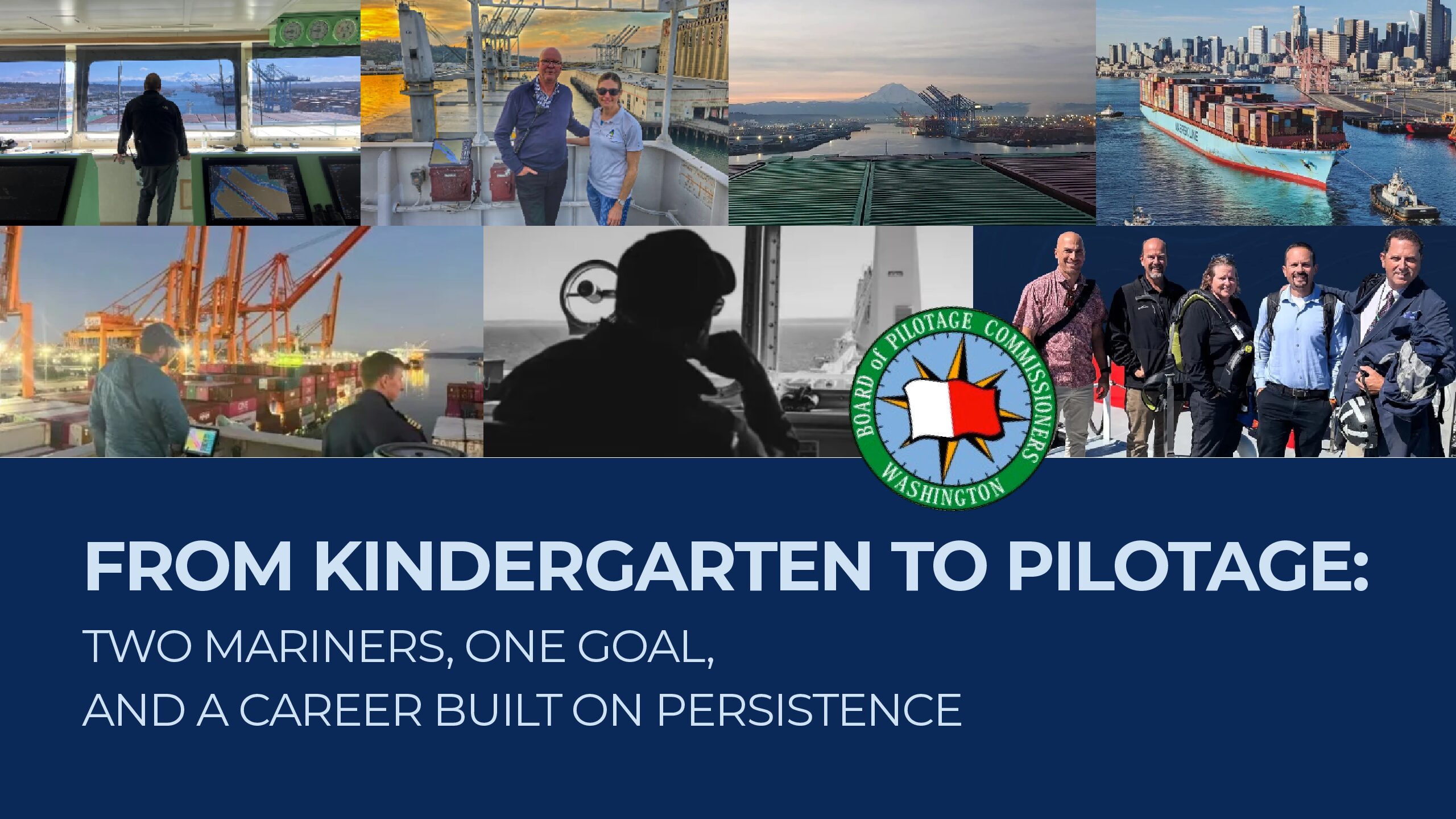
Editor’s Note: This article is adapted from a story originally published in the BPC Pilotage Quarterly – Winter 2026 Special Edition by the Washington State Board of Pilotage Commissioners. The original article shared the journey of Captains Joel Michelson and Harlow Wood as they completed the path to becoming Puget Sound Pilots. We are grateful for the opportunity to share their story with the Women Offshore community.
When people think about maritime careers, they often picture a straight path from the maritime academy to the bridge. In reality, many careers on the water take unexpected turns.
For Captains Joel Michelson and Harlow Wood, the road to pilotage included childhood friendships, years aboard Washington State Ferries, higher education, career pivots, and a shared commitment to a goal that offered no guarantees.
Their story is a reminder that success in maritime is rarely about taking the perfect route. It’s about persistence, adaptability, and continuing to move forward when opportunities arise.
What Is Pilotage?
Pilots are highly trained mariners responsible for safely guiding vessels through challenging waterways. In Washington State, becoming a pilot requires years of experience, extensive preparation, and a rigorous examination process.
The journey demands more than technical knowledge. It requires resilience, discipline, and a willingness to dedicate years toward a highly competitive goal.
For many mariners, pilotage represents the culmination of decades spent building experience across different vessel types, operational environments, and leadership roles.
Different Paths, Shared Destination
Although Michelson and Wood grew up in the same community of Poulsbo, Washington, their careers developed along very different tracks.
Michelson knew from an early age that he wanted to work on the water. Inspired by time spent around Washington State Ferries with his father, he pursued opportunities with the ferry system while simultaneously studying art photography. After joining the ferries as an Ordinary Seafarer, he steadily advanced through the ranks, gaining experience and credentials along the way.
Wood’s path looked very different.
After graduating from the United States Merchant Marine Academy with a degree in Marine Transportation and an Unlimited Third Mate license, he attended law school and passed the Washington State Bar Exam. While exploring legal career opportunities, he also joined Washington State Ferries, recognizing that it allowed him to stay connected to the maritime industry while remaining close to home.
Despite their different backgrounds, both men ultimately found themselves pursuing the same long-term goal.
The Power of Mentorship and Community
One of the most compelling parts of their story is the role that community played in their success.
Years after losing touch, Michelson and Wood reconnected through a conversation about advancing within the ferry system. That conversation eventually evolved into a study partnership that would support them through one of the most demanding professional challenges of their careers.
Preparing for a pilotage examination requires months of intensive study, technical mastery, and mental endurance. Having a trusted colleague to share the workload, discuss difficult concepts, and maintain accountability proved invaluable.
Their experience highlights something we hear often throughout the Women Offshore community: maritime careers are rarely built alone.
Whether it’s a mentor offering guidance, a shipmate sharing knowledge, or a study partner helping navigate a challenging credential, strong professional relationships can make a significant difference.
There Is No Single Route to Leadership
One lesson from this story stands out above the rest: there is no single formula for success in maritime.
One mariner studied photography. Another earned a law degree.
One path was shaped by a lifelong dream of becoming a pilot. The other included a serious exploration of a legal career.
Yet both journeys led to the same destination.
For women entering maritime today, that lesson is particularly important. Careers on the water do not always unfold exactly as planned. Opportunities emerge, industries shift, and personal priorities evolve.
The skills developed along the way, leadership, communication, adaptability, technical expertise, and problem-solving, often become just as valuable as any credential.
Looking Ahead
Today, Captains Michelson and Wood have achieved a milestone that requires years of dedication and commitment. More importantly, they have become part of the next generation of maritime leaders who will help guide and mentor those coming behind them.
At Women Offshore, we believe stories like these matter because they provide visibility into the many pathways available throughout the maritime industry. Whether your goal is pilotage, vessel operations, engineering, offshore energy, research, ferries, or another sector entirely, there is rarely one correct route.
The maritime industry needs people with different experiences, different perspectives, and different backgrounds.
Sometimes the journey begins in a classroom. Sometimes it begins aboard a vessel.
And sometimes, as this story shows, it begins with two kindergarten classmates who reconnect years later and help each other reach the bridge.
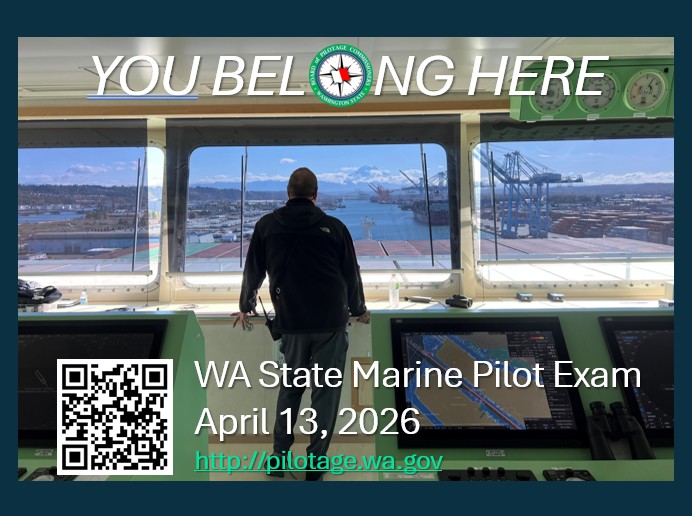
To learn more about pilotage careers in Washington State, visit the Washington State Board of Pilotage Commissioners.
Watch for more on their story as well as their #PathtoPilotage series on their socials! LinkedIn, Facebook, Instagram
Related posts:
 Sailing into Purpose: Phoebe Rogers on Adventure, Adversity, and Transformation at Sea
 Breaking Barriers: The Inspiring Journey of Commander Pawlak-Zientarska
 Redefining Career Paths: Svetlana Klockova, From Finance to Offshore Surveying
 Navigating the Welfare Waters: ISWAN’s 2024 Annual Review for Yacht Crew
 Women Offshore Named 2025 Mentorloop Impact Award Winner

Recent Comments