
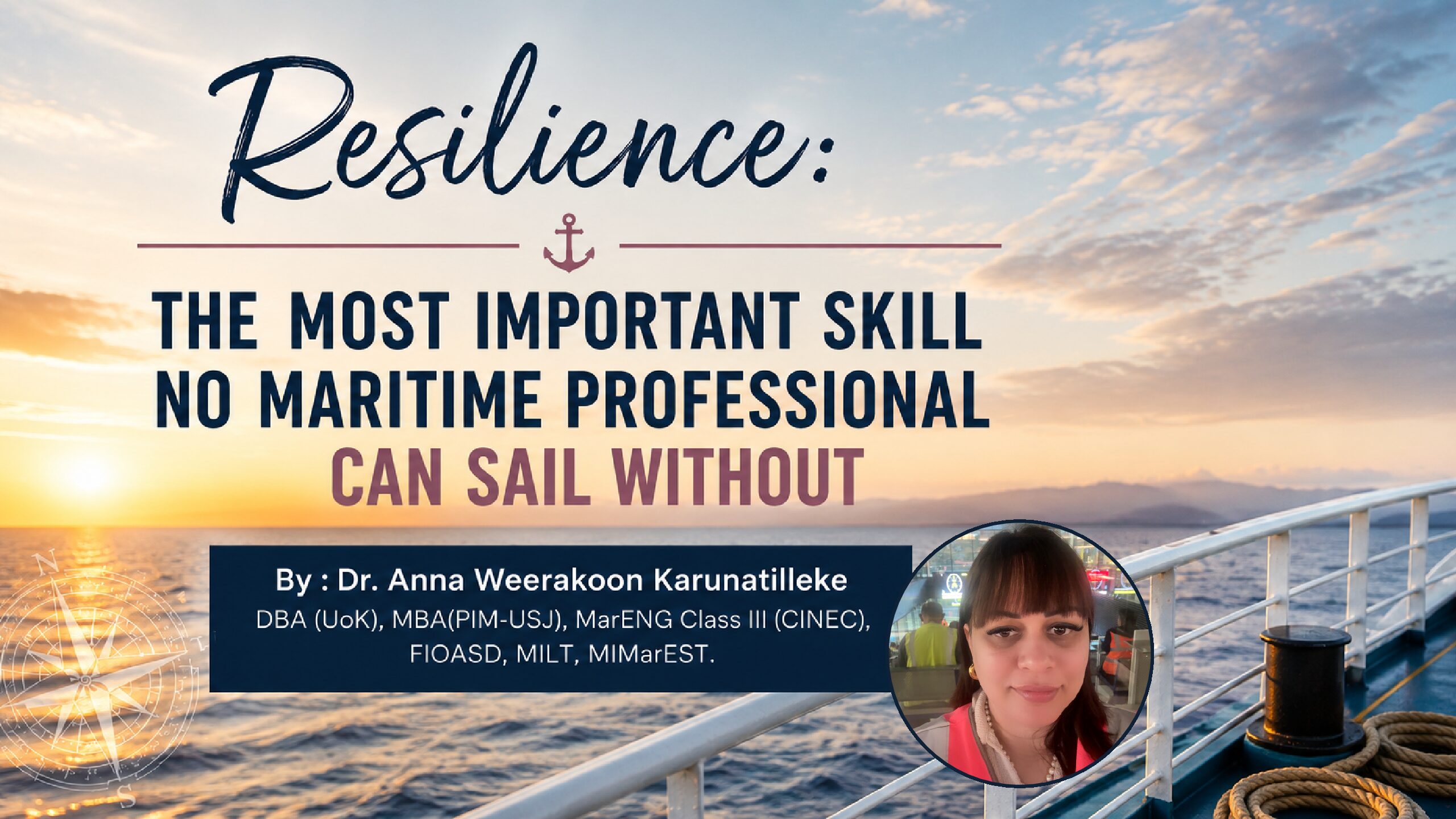
By Dr. Anna Weerakoon Karunatilleke
DBA (UoK), MBA (PIM-USJ), MarENG Class III (CINEC), FIOASD, MILT, MIMarEST.
When people think about the maritime industry, they often picture ships, engines, ports, and life at sea. But behind every successful maritime professional is something far less visible: resilience.
Technical knowledge earns qualifications. Experience builds expertise. But resilience is what keeps you moving when opportunities disappear, doors close, and the future feels uncertain.
Looking back on my own journey, I realize resilience—not talent or luck—has been the defining factor in my career.
A Journey That Began Between Two Worlds
My story began long before I entered the maritime industry.
My father, a Sri Lankan mathematician, left for Russia after completing his advanced-level studies to pursue higher education. While earning his PhD in Moscow, he met my mother, a Ukrainian mathematician who had earned a bronze medal in the regional Russian Mathematics Olympiad. Their shared passion for mathematics brought together two cultures, and on March 12, 1988, I was born in Moscow.
As a child, I eventually moved to Sri Lanka, where school became one of the happiest chapters of my life. I loved learning, taking on responsibility, and participating in every opportunity available. Leadership came naturally, and I served as a class monitor, president of the literary association, and school prefect.
At that stage, I imagined a future in technology. Programming fascinated me, and I spent countless nights teaching myself new skills, often working until the early hours before returning to school the next morning.
Then everything changed.
Choosing an Unconventional Path
During my advanced-level studies, representatives from CINEC visited our school to introduce students to careers in the maritime industry.
Something about ships, engineering, and life at sea immediately captured my imagination.
When I told my computer teacher that I wanted to become a marine engineer, he laughed.
“I thought you’d lead the computer industry one day. Why become a seafarer?”
But sometimes the path that makes the least sense to others is the one that feels right to us.
In 2007, I joined CINEC, completed my cadetship and workshop training, and eventually qualified as a marine engineer.
I believed the hardest part was over.
I was wrong.
When Every Door Closed
After getting married in 2013, both my husband and I struggled to find employment.
Day after day, I visited shipping companies, government organizations, and private businesses carrying my résumé. Many rejected me without offering an interview. At some companies, I wasn’t even allowed through the front gate.
For someone who had worked so hard to qualify, those months were heartbreaking.
One evening, sitting alone in front of my computer, I reached one of the lowest points in my life.
Although I had always considered myself an atheist, I quietly knelt down and said,
“God… if you are there… please give me a job.”
Afterward, I opened the employment website I checked every day.
There was one new advertisement.
A marine engineer with AutoCAD knowledge.
I submitted my application, but the online system failed.
The following morning, instead of giving up, I traveled directly to the company and handed over my résumé in person.
Even then, I overheard someone say,
“A girl? Tell her to go home.”
Many people would have walked away.
Instead, I prepared.
Knowing there would be an AutoCAD assessment, I traveled to the University of Moratuwa and taught myself the software in less than two days, including basic 3D modeling.
That preparation became one of the most important investments I ever made.
The Opportunity That Changed Everything
I was eventually offered an interview and a three-month probation period.
Those three months changed my life.
Soon afterward, my husband joined the same organization, and together we relocated to Beruwala.
I was entrusted with leading a shipyard project that eventually became known as “Anna’s Yard.” Under the guidance of Dr. Obeysekara, who believed in me when many others did not, the project grew into what would later become Walkers Colombo Shipyard.
That experience taught me another valuable lesson.
Opportunity may arrive unexpectedly, but it only rewards those who are prepared to seize it.
Reinventing Myself Again
As the company continued to grow, I noticed something difficult to ignore.
Some employees who joined after me earned significantly higher salaries simply because they held government university degrees.
Rather than becoming discouraged, I chose to invest in myself.
Initially, I planned to study mechanical engineering through the Open University. Instead, someone encouraged me to pursue an MBA at the Postgraduate Institute of Management.
I applied.
Despite doubts—even from people close to me—I was accepted and graduated with a perfect 4.0 GPA.
That achievement opened another chapter.
I later established my own consultancy and continued my academic journey by pursuing a Doctor of Business Administration at the University of Kelaniya after an earlier unsuccessful application elsewhere.
Earlier this year, I completed my doctorate, becoming one of the youngest graduates of the program.
More recently, I was selected to participate in an international research collaboration involving DFAT, the University of Wollongong, and ANCORS in Australia.
Today, I also serve as a Women Offshore Ambassador while continuing to contribute to the maritime industry through research, leadership, and professional development.
What the Maritime Industry Taught Me About Resilience
People often ask what it takes to succeed in maritime.
Many expect the answer to be intelligence, technical expertise, or leadership.
Those qualities certainly matter.
But resilience matters even more.
This industry is filled with uncertainty. Contracts end. Markets fluctuate. Ships change ownership. Opportunities disappear. Careers rarely follow a straight line.
The professionals who succeed are not necessarily those who never experience failure.
They are the ones who continue applying after rejection.
They continue learning after setbacks.
They prepare even when no opportunity is guaranteed.
Most importantly, they refuse to let temporary disappointment become a permanent destination.
A Final Thought
When I reflect on my career, I realize every opportunity began as uncertainty.
Every achievement followed rejection.
Every milestone started with a decision not to give up.
Resilience is not simply about surviving difficult moments.
It is about choosing to keep moving forward when success is nowhere in sight.
The maritime industry needs skilled professionals.
But above all, it needs resilient ones.
Because sometimes the opportunity that changes your life is hidden behind the door that almost never opened.
Related posts:
 From Kindergarten to Pilotage: Two Mariners, One Goal, and a Career Built on Persistence
 The Bucket List Crew: Why More Mariners Are Choosing Purpose Over Partying
 Redefining Career Paths: Svetlana Klockova, From Finance to Offshore Surveying
 Ade Solorzano: Chief Mate Advocating for Safety, Visibility, and the Next Generation of Women at Sea
 Maritime Action Plan: What It Means for the Future of Maritime Careers



Recent Comments