
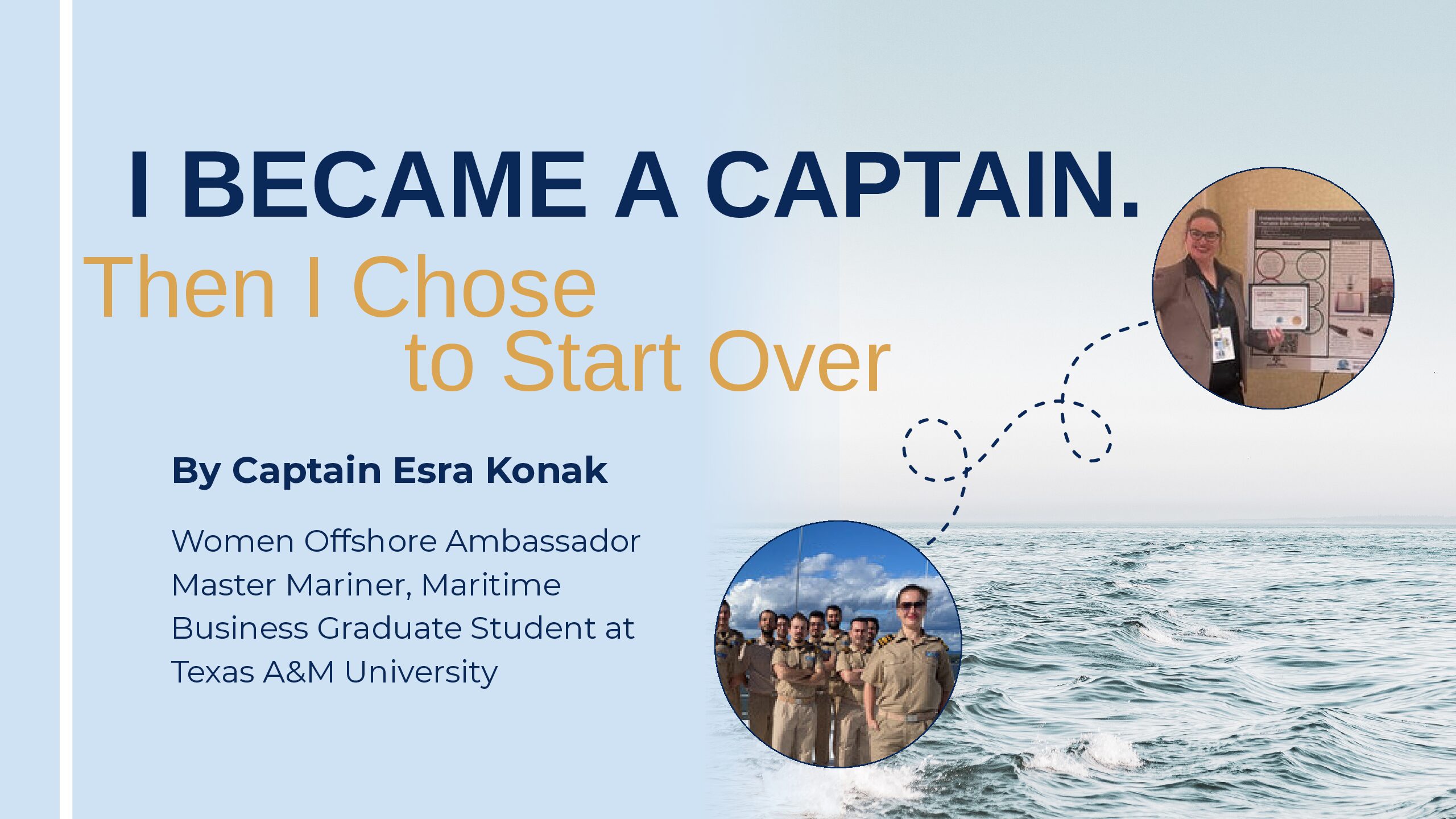
By Captain Esra Konak
Master Mariner | Maritime Business Graduate Student at Texas A&M University
People often think the most challenging part of my career was becoming one of the first few women to ever serve as a Master on chemical tankers in Türkiye.
It wasn’t.
During more than fifteen years at sea, I learned that leadership is rarely shaped by calm voyages. It is forged in moments of uncertainty, when every decision carries consequences for the people who have put their trust in you.
One such experience changed me more than any other.
One early morning, in the winter of 2022, just months into Russia’s war on Ukraine ( or Russia-Ukraine conflict if you like ) I navigated my tanker up the historic Danube, to the Ukrainian port of Izmail, anticipating a quick turnaround.
However, Russia began intensifying its missile and drone attacks on Ukrainian ports and critical maritime infrastructure at this time, compelling local authorities to order all ships to temporarily remain at port.
At first, my executive staff and I thought it might be a 48 hour hold, but that became 72 hours. Soon days turned into weeks.
As the Port of Odesa, a mere hundred nautical miles from our position, came under fire, we are told no vessels will be given permission to depart for the foreseeable future. No one knows when it will be safe to leave, or whether our ship will become the next target of a missile or drone attack or fall victim to deflected missile defense rockets. The danger is real.
Every tense day becomes an exercise in leadership, managing the perilous uncertainty.
Together with my Chief Engineer, Chief Officer, and Chief Cook, I carefully monitored our fuel, freshwater, provisions, and power generation while ensuring that the crew remained calm, focused, and, above all, safe.
Late one night in our third week or so, suddenly an air raid siren snapped us out of our routines, causing my team to immediately scramble into action. We were fortunate that the air defenses held, but the response of my crew reassured me that all were prepared for whatever would happen.
During what became more than two months of uncertainty, I learned one of the most important lessons of my career. People do not expect a captain to have all the answers. They expect a captain to remain steady when uncertainty surrounds everyone else.
When a safe window finally opened, we departed Izmail after sixty-three days at berth. Managing the day to day of the crisis, keeping the crew focused and prepared, and ultimately bringing my ship and crew safely out of an active conflict zone would become one of the greatest leadership accomplishments of my career.
After more than fifteen years at sea, 2 years ago, I packed my life into two suitcases and moved to the United States to pursue a graduate degree in Maritime Business at Texas A&M University at Galveston.
Falling in Love with the Sea
I grew up in Antalya, Türkiye, where the sea was part of everyday life. Long before I understood what it meant to become a ship’s captain, I knew I wanted a life connected to the ocean.
While many girls were encouraged to choose more traditional careers, I was fascinated by ships, navigation, and the opportunity to explore the world beyond the horizon. The sea represented both freedom and responsibility, and I knew it was where I belonged.
That dream led me to Istanbul Technical University, where I studied Maritime Transportation and Management Engineering and graduated in 2009.
Even before graduation, I understood that my journey would not be an easy one. At the time, female officers were still rare, especially on chemical tankers. There were moments when people questioned whether I belonged on board before they had even seen me do my job.
Instead of trying to convince them with words, I decided to let my performance speak for itself.
I never set out to become one of the few women to command a chemical tanker. My goal was much simpler—to become the best maritime professional I could be. Looking back, I realize that commitment to learning, professionalism, and continuous improvement became the foundation of every opportunity that followed.
Learning Through Every Voyage
During the next fifteen years, I worked almost exclusively on oil and chemical tankers, one of the most technically demanding sectors of the maritime industry.
Those years took me farther than I could ever have imagined. I had the privilege of sailing across every major ocean and visiting more than eighty countries. Every port introduced me to a different culture. Every voyage broadened my perspective. Every challenge taught me something new about leadership.
Chemical tankers require precision, discipline, and teamwork. Every cargo has different characteristics, every operation demands careful planning, and even a small mistake can have significant consequences.
Throughout my career, I navigated the Bosphorus and the Dardanelles, crossed the Suez and Panama Canals, and operated in piracy-risk areas. Along the way, I experienced engine room fires, collisions, serious crew injuries, machinery failures, prolonged operational emergencies, and yes, conflict zones that reinforced the importance of remaining calm under pressure.
Eventually, I became one of only three women in Türkiye to serve as a Master on chemical tankers.
In 2021, I was honored to receive Türkiye’s Women’s Leadership Award. More meaningful than the award itself was what it represented. It reminded me that our industry is still evolving and that every woman who succeeds at sea helps make the path a little easier for those who follow.
One lesson became clear after every voyage.
The Courage to Begin Again
After reaching the position of Master, many people expected me to continue sailing until retirement.
But deep down, I knew there were still new waters to explore.
Shipping was evolving rapidly. Digitalization, sustainability, were transforming our industry, and I wanted to understand not only how ships operate at sea, but also how decisions are made ashore.
So, I made the most difficult decision of my career.
I left the bridge.
I packed my life into two suitcases and moved to the United States to pursue a graduate degree in Maritime Business at Texas A&M University at Galveston.
Starting over was far more challenging than I had expected.
For the first time in many years, nobody called me “Captain.”
I was simply Esra—an international student learning in a second language, adapting to a new education system, and building a new professional network all over again from the beginning.
There were moments when I questioned my decision. But whenever doubt appeared, I reminded myself of something the sea had already taught me:
Growth has never existed inside my comfort zone.
Looking back, I realize I wasn’t leaving the maritime industry behind.
I was simply sailing toward a different horizon.
Discovering a New Side of the Maritime Industry
This summer, I had the opportunity to intern with Stolt Tankers in Houston, where I experienced the commercial side of shipping for the first time.
After spending more than fifteen years at sea, stepping into an office was both unfamiliar and exciting. For years, I had seen the results of decisions made ashore. Now, I had the opportunity to understand how those decisions were made.
Coming from a seagoing background showed me how closely chartering, operations, technical management, and commercial planning work together to keep global trade moving safely and efficiently.
One of my projects involved reviewing and updating the particulars of more than one hundred vessels, requiring technical accuracy and close collaboration across departments.
Although the environment was completely different from a ship, I quickly realized that the same qualities I had relied on at sea—discipline, communication, teamwork, and problem-solving—were equally valuable ashore.
Toward the end of my internship, my supervisor shared my evaluation with managers across the department and described me as “an incredible intern.”
Those words meant more to me than they probably realized.
Not because they praised my work, but because they reminded me that experience never disappears.
It simply becomes valuable in new ways.
At that moment, I realized something important.
I had not left shipping.
I had simply found a new way to contribute to it.
Looking Ahead
Today, my journey continues.
I no longer stand on the bridge of a chemical tanker, but my purpose has not changed.
I hope to combine my operational experience at sea with business strategy, leadership, and innovation to help shape the future of the maritime industry.
Throughout my career, I have often been asked what it is like to be a woman in shipping.
My answer has changed over the years.
I don’t want to be recognized only as a female captain.
I want to be recognized as a maritime professional always pursuing excellence, who also happens to be a woman.
The maritime industry needs talented people with different experiences, perspectives, and ideas. I hope my journey encourages more women to believe they belong—not because someone gave them permission, but because they earned their place through competence, resilience, and hard work.
Looking back, I do not define my career by the rank I achieved.
I define it by my courage to keep learning.
The sea taught me discipline.
Every port taught me something unique.
Every ocean made me a better navigator.
Every challenge made me a better leader.
Because the hardest voyage of my life was not crossing an ocean.
It was having the courage to leave the bridge and begin again.
Related posts:
 Maritime Action Plan: What It Means for the Future of Maritime Careers
 Finding Purpose Beyond the Uniform
 From Shipboard HR to Industry Changemaker: How Keely Gavin is Redefining Leadership at Sea
 Steady Success of Christalove Agyin-Ayetse
 From Kindergarten to Pilotage: Two Mariners, One Goal, and a Career Built on Persistence

Recent Comments